

Core Location: Nucleus
Harmonics are earthly gems. They are part of what create the sonic signature of any given sound. All naturally occurring sounds and tones have a mix of frequencies which co-mingle to create the overall quality of what we hear. Studying harmonics (overtones) is to study acoustics.
Harmonics, in acoustics (the physics of sound), are a series of tonal oscillations which make up a vibrating tone. They are added up, or integrated into a unified shape of sound perceived in terms of loudness, duration, tone color (timbre), and pitch by a perceiving subject (every subject has a given set of perception capabilities and limitations).
Our voices are a collection of harmonics. Depending on our physiology and types of voices we use, we create blocks of sounds which have a fundamental (base tone or frequency) with a mix of ringing overtones or harmonics. The human voice is generally the middle frequencies of the sonic spectrum.
One way we can play (isolate) harmonics on the guitar is to touch a string lightly at particular locations (do not press against a fret, but touch lightly) and pluck or slap the string. Some places along the string plane produce stronger harmonics (lower and more whole ratios).
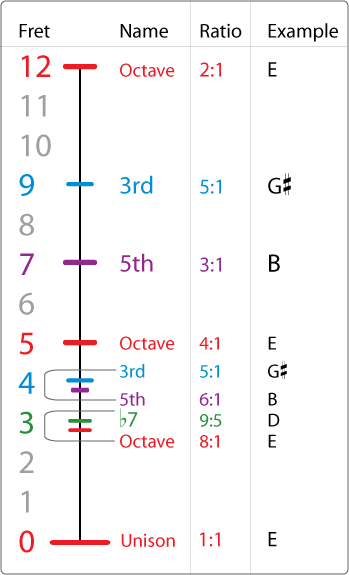
Every tone has other types of vibratory potentials and 'actuals' within it. We see in the series above that E contains many other tones. The strongest of which are a dominant type chord.
Some frets have more than one harmonic per fret space [eg. the 3 and 4].
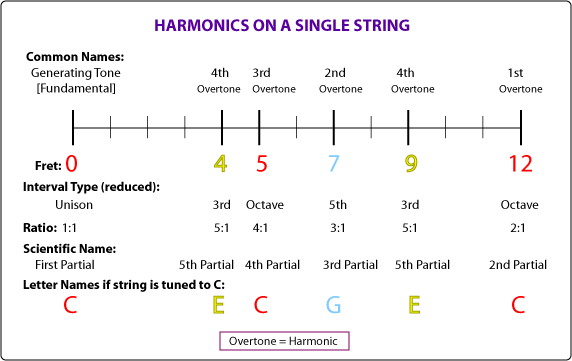
This example shows the very basic ratios for the tone C.
The terms overtone and harmonic are the common names for the phenomenon of harmonics. These two terms are used interchangeably and mean the 'same thing'. The only tone in the series that is not an overtone or harmonic is the fundamental or generating tone.
The term partial is the scientific name for 'harmonics'. In this case the generating tone is also called a partial (first partial). All subsequent partials are numbered. Partial numbering is always one more than the overtone numbering. This is a technical issue and should not divert attention away from the experience of harmonics.